Feeding and Food Aversions in Lafayette
You were told he would eat when he got hungry enough. He did not. A child down to six foods is not being stubborn, and a standoff at dinner is not a plan.
What causes feeding difficulty and food aversions?
Picky eating and a feeding difficulty look similar from across the table and they are not the same thing. A picky eater has a short list and eats from it. A child with a feeding difficulty is losing foods rather than gaining them, and there is almost always a reason underneath: how the mouth moves, how a food feels, or what happened the last time something went wrong.

Chewing is a learned motor pattern. A child has to move food from the middle of the tongue out to the molars, grind it, gather it back into a ball and swallow it safely. When the tongue does not move sideways well, or the jaw is not steady and graded, meat, raw vegetables and mixed textures become genuinely hard work. Children solve that by refusing them. From the outside the refusal looks like preference.
One choke, one gag that went too far, or one vomiting illness during a meal can rewrite how a child approaches the table for years. The brain is doing exactly what it evolved to do: avoid the thing that felt dangerous. Afterwards a child may drop not only that food but everything resembling it in color, smell or texture. Pressure at that point makes things worse, because it lays a second unpleasant memory on top of the first one.
Some children experience food far more intensely than the adults serving it. A wet texture, a smell drifting in from the next room, a sauce touching a cracker, or the temperature of a spoon can be enough to end the meal. This is not defiance and it does not respond to bargaining. It responds to graded, predictable exposure that starts far enough away from the food to be tolerable and moves closer at a pace the child can actually handle.
Appetite is one of the first things to disappear when a body is uncomfortable. Reflux, constipation, food allergy or intolerance and chronic congestion all reduce how much a child wants to eat and how willing they are to try anything new. A child who feels full, sore or unwell learns quickly that eating is not worth it. This is why we ask about sleep, stooling and growth at the evaluation, and why we work alongside your pediatrician rather than around them.
A difficult start often leaves a trail. A restricted tongue, a long stretch of bottle refusal, a NICU stay, tube feeding, or months of painful reflux all shape how a child relates to eating well past infancy. The original problem may be long gone while the pattern it created stays. Knowing what the first year looked like changes where we start, because a child avoiding textures after early tongue restriction needs different work than a child avoiding them after a choke.
Nobody plans this. When a child eats almost nothing, a family does what any family would do: a separate meal gets cooked, the tablet comes out to buy ten more bites, dinner stretches to an hour, and everyone starts negotiating. Those responses are reasonable and they slowly teach a child that eating is a battle to be managed. Part of the work is rebuilding what a meal looks like in your house, at a pace that does not blow up the evening.
How feeding therapy in Lafayette helps.
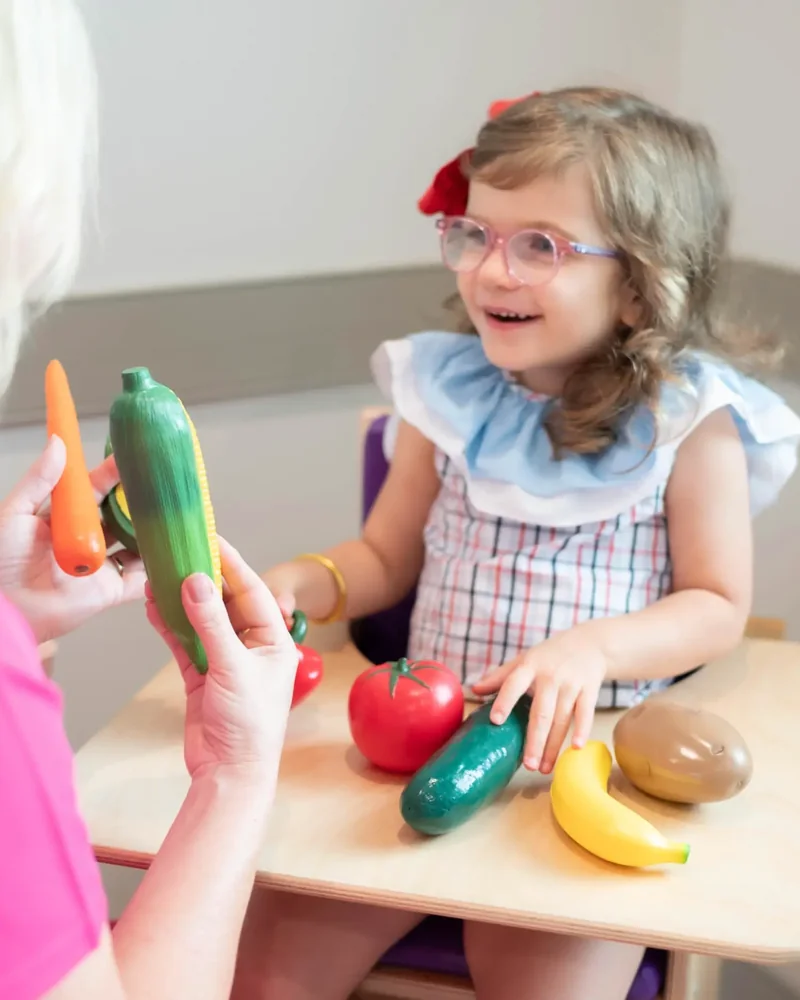
He will eat when he is hungry is advice almost every parent who calls us has already tried. Children with a real feeding difficulty do not simply give in, and hunger is not a teaching tool. So we start somewhere else. The evaluation looks at how your child chews and swallows, how textures get handled, what the medical history explains, and what a meal really looks like in your house. From there the plan is built in small, deliberate steps: tolerate the food nearby, touch it, smell it, hold it to the lips, taste it, chew it. No child is pressured and no bite is forced, because force is what shrank the list in the first place. You are in the room learning the same steps, since dinner happens at your table and not ours. At the evaluation we give you an honest estimate of the timeline, and we tell you what we are seeing as we go.
What to expect.
Pinpoint
The first visit is an evaluation. We look at how your child chews, moves and swallows food, work through the medical and early feeding history, and ask you to describe a normal weeknight meal honestly. You leave with a clear picture of whether this is a skill problem, a sensory one, a medical one, or some combination, plus an honest estimate of the timeline.
Prime
Then we build the missing pieces. That may mean chewing and tongue movement work, jaw stability, or graded exposure that starts with a food simply being on the table and moves forward only when your child is comfortable. The steps are small on purpose. Progress that gets forced tends to reverse the first time a meal goes badly.
Perform
Finally the new foods move home. We work with your actual menu, your table and your schedule, and we give you the language to use when a meal goes sideways so it does not turn into a standoff. The goal is a family eating one dinner together, and a child whose list of foods is growing rather than shrinking.
As a first time and full time working mom, I was nervous about starting baby led weaning while feeling like I didn't have enough time to sleep, much less research enough.
Where feeding trouble often starts.

Infant Feeding and Tongue Tie
Painful latch, clicking and feeds that never end. Often where a later feeding difficulty first began.

Orofacial Myofunctional Therapy
Tongue posture, mouth breathing and swallow patterns that make chewing harder than it needs to be.

Speech, Fluency and Language Support
The same tongue and jaw that handle food shape sounds. Feeding and speech often travel together.