Orofacial Myofunctional Therapy in Lafayette
The dentist mentioned the tongue. The orthodontist mentioned the mouth breathing. Nobody explained that the muscles doing it can be retrained.
What causes orofacial myofunctional disorders?
An orofacial myofunctional disorder is a pattern, not an accident. The tongue rests low instead of up against the palate, the lips stay apart, and the swallow pushes forward instead of lifting. Held for years, those habits shape how the jaw grows, whether teeth stay where braces put them, and how clearly certain sounds come out. The causes are usually mechanical, and they are usually addressable.
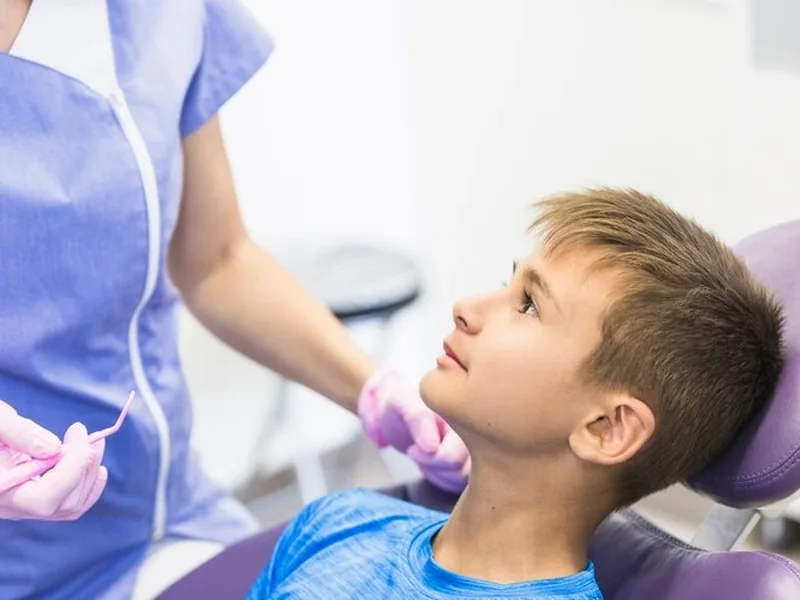
At rest, the tongue is meant to sit up against the roof of the mouth with the lips gently closed. That resting position is a light, constant force that helps shape the upper arch through childhood. When the tongue drops to the floor of the mouth instead, the palate loses its natural spreader and the arch tends to narrow. Because it happens across years rather than weeks, there is never a day when anyone notices it change. The useful part is that resting posture is trainable at almost any age.
A child who cannot breathe comfortably through the nose will breathe through the mouth, and the tongue has to drop out of the way for that to work. Enlarged tonsils and adenoids, chronic allergies and long stretches of congestion are the usual reasons. Mouth breathing then dries the tissues, locks in the low tongue posture, and often disturbs sleep. This is why we ask about snoring, restless nights and daytime tiredness, and why the airway sometimes has to be addressed by an ENT before muscle work will hold.
Every infant swallows by pushing the tongue forward. Most children trade that in for a mature swallow, where the tongue tip lifts to the palate and the middle of the tongue moves food back. When the forward push persists, it delivers a steady outward pressure against the front teeth thousands of times a day. It is a common reason an open bite reopens after orthodontic work, and it is one of the specific patterns myofunctional therapy is built to retrain.
A tongue cannot rest against the palate if it cannot reach the palate. A restrictive frenulum limits elevation and sideways movement, so a low resting posture is not really a habit, it is the only option available. Assessment here is functional: what the tongue can lift, hold, sweep and cup, not simply how the tissue looks in a photo. When a release is appropriate, the exercises before and after it are what turn new range into a new resting position rather than a return to the old one.
Thumb sucking, extended pacifier use, nail biting and cheek chewing all apply repeated force in places a growing mouth is sensitive to. Past a certain age they can hold the front teeth apart, narrow the arch and keep the tongue in a forward, low position. The habit and the muscle pattern reinforce each other, which is why taking the pacifier away often does not fix the bite by itself. The replacement pattern has to be taught, not just the old one stopped.
The same muscles that hold a swallow together produce the sounds that need a tongue tip: s, z, t, d, n, l and r. When the tongue works from a low, forward position those sounds drift, and a lisp is often the first thing anyone notices. Older children and teens may also report jaw tension, clicking or headaches from clenching and from a jaw that has been compensating. Treating the underlying pattern usually addresses more than one complaint at once.

How myofunctional therapy in Lafayette helps.
Braces move teeth. Muscles decide whether the teeth stay where the braces put them. That gap is what myofunctional therapy fills, and it is why so many families arrive here on a dentist's or an orthodontist's suggestion with very little explanation attached to it. The work itself is specific and unmysterious. We assess resting tongue and lip posture, tongue range, the swallow pattern, breathing, and any oral habit still feeding the problem, then prescribe a short daily set of exercises that retrain the muscles into a new default. Progress depends on that practice happening at home, so we keep the routine short and we teach it to you as well as to your child. If nasal breathing is blocked, we say so and point you back toward an ENT, because muscle work will not hold against an airway that cannot cooperate. No referral is needed to book the evaluation. Coverage for this work varies, so we verify your benefits and tell you the real number before your first visit.
What to expect.
Pinpoint
The evaluation looks at the whole pattern: where the tongue rests, whether the lips seal, how your child swallows and breathes, what the tongue can physically reach, and which habits are still in play. We ask about snoring, sleep and dental history too. You leave knowing which parts are muscle, which parts are structure, and which parts belong to another provider.
Prime
Then we retrain the default. A short daily set of exercises builds tongue elevation, lip seal, nasal breathing and a mature swallow, and each one is taught until your child can do it without a mirror or a reminder. This is habit work, so consistency beats intensity. A few focused minutes a day does more than one long session a week.
Perform
Last, the new posture has to hold when nobody is watching: asleep, at school, mid sentence, mid meal. We check it in those situations, adjust anything that is slipping, and coordinate with your dentist or orthodontist so their work and ours point the same direction. You go home with a maintenance routine that keeps the pattern after discharge.
What often travels with it.

TMJ Disorders
Jaw tension, clicking and clenching that often travel with a low tongue posture and a forward swallow.

Infant Feeding and Tongue Tie
Tethered tissues limit where the tongue can reach, and often explain why a resting posture never developed.

Speech, Fluency and Language Support
A lisp is usually the first sign anyone notices. Tongue tip sounds depend on the same muscles.