Infant Feeding and Tongue Tie in Lafayette
Everyone told you the latch would settle. It has been weeks. You are not imagining the pain, the clicking, or the feeds that never seem to end.
What causes feeding trouble and tethered oral tissues?
A newborn feed depends on a seal, a suck, a swallow and a breath arriving in the right order, hundreds of times a session. When one of those is off, the whole feed changes shape. Sometimes the reason is structural, sometimes it is coordination, and sometimes it is a baby who compensates so well that the only clue left is how tired everyone is.

The lingual frenulum is the band of tissue under the tongue. When it is short, thick or attached close to the tip, the tongue cannot lift, cup or extend the way a feed requires. Babies compensate by clamping with the gums or the jaw, which is where the pain, the shallow latch and the clicking usually come from. What matters is not how the frenulum looks but what the tongue can actually do, which is why assessment is a movement exam rather than a glance.
A tight upper lip attachment can stop the lip from flanging out over the breast or bottle, so the seal breaks and air gets in. Buccal ties in the cheeks are less common and easier to miss, but they reduce the tension that helps hold a latch steady. Air in means gassiness, fussing and a baby who unlatches to regroup every minute.
Pain is information, not something to endure. A latch that pinches, a nipple that comes out creased or flattened, cracking that never heals, and a feed you find yourself dreading are all signs that the baby is compressing rather than drawing milk. Left alone this leads to lower transfer, longer feeds, and a supply that starts to follow the demand downward. The latch is fixable, but only once we know what is making it shallow in the first place.
When a baby cannot move milk efficiently, the feed stretches to compensate. Forty five minutes becomes an hour, the baby falls asleep at the breast, wakes hungry twenty minutes later, and nobody in the house is sleeping. Slow weight gain is the version of this that gets flagged at the pediatrician. The version that does not get flagged is a baby who gains adequately while a parent feeds around the clock to make it happen.
A broken seal lets air into the stomach with every swallow. That shows up as clicking sounds during the feed, popping on and off, arching, hiccups, spitting up, and long stretches of inconsolable evening fussing. Reflux medication is often the first thing offered, and sometimes it quiets the symptoms while the cause carries on underneath. If the seal is the problem, the air is the symptom, and changing the mechanics of the feed is what changes the evenings.
The same restrictions that make breastfeeding hard can make a bottle hard, and they follow a baby forward. A tongue that cannot lift and move sideways struggles to shift food across the mouth when solids arrive, so purees are tolerated and textures are not. Parents are often told this is a phase to wait out. It is worth checking the mechanics first, because the earlier a tongue learns a new pattern, the less there is to undo later.
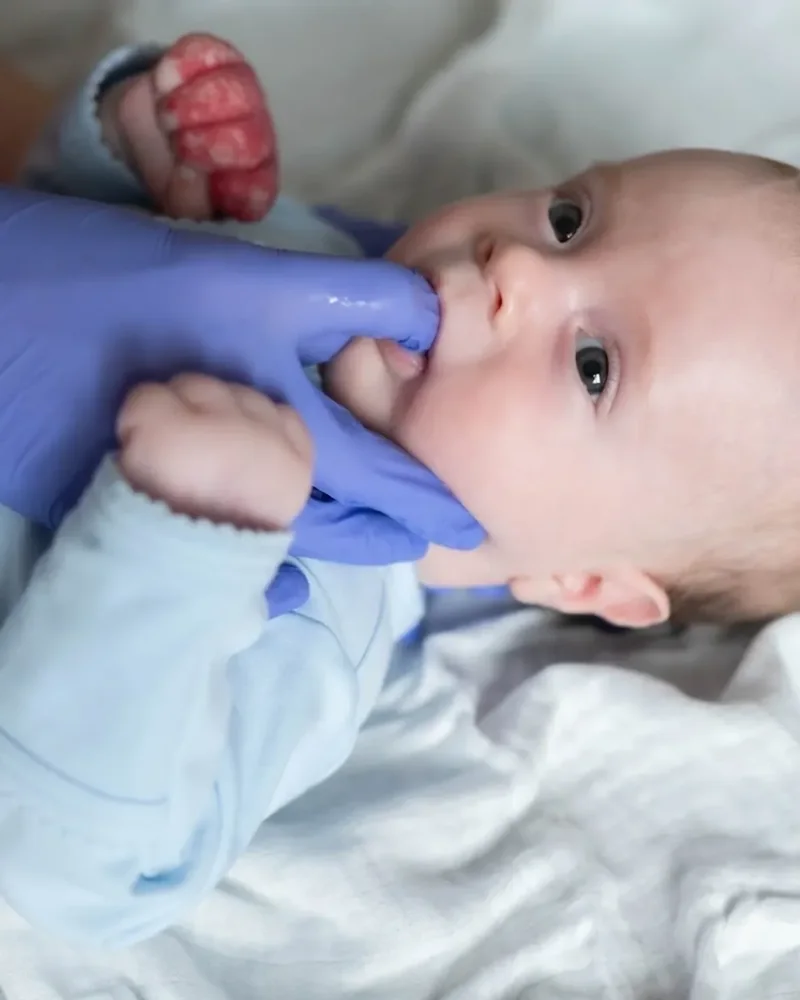
How feeding therapy in Lafayette helps.
You have probably been told to try a different hold, a different bottle, or to give it one more week. Here is what we do instead. The evaluation is functional: we watch an actual feed, look at what the tongue, lips and jaw can do, and check how the suck, swallow and breath fit together, not just what the anatomy looks like. If a restriction is limiting the feed, we tell you plainly what we see and what a release would and would not change, and we coordinate with your pediatrician when that is the right path. Much of the work is oral exercises and gentle body work before and after any procedure, because a tongue that has never moved that way has to learn how. You are in the room with your hands on your baby, because you are the one doing the next feed at two in the morning. No referral is needed to book the evaluation, and we verify your benefits and give you the real number before your first visit.
What to expect.
Pinpoint
We start by watching a real feed, not a description of one. Then we assess what the tongue, lips, cheeks and jaw can actually do, listen to the swallow, and ask about weight, sleep, gas and your own pain. You leave the first visit knowing what we found, what it means, and whether a release is even part of the conversation.
Prime
Next we build the movement the feed needs. Oral exercises, positioning changes, suck training and gentle body work help a baby lift, cup and extend the tongue and hold a seal. If a release is planned, this work happens before and after it, because the procedure creates the room and the exercises teach the tongue what to do with it.
Perform
Then the new pattern moves into real feeds, at home, at night, on your schedule. We adjust as your baby grows and as bottles or solids enter the picture, and we send you home with a short daily routine you can actually keep. The aim is a feed that ends in twenty minutes instead of an hour, and a house that sleeps.
I can't say enough good things about our experience with Mrs. Sarah Tate! As a new mom, I was really struggling with my baby's latch during breastfeeding, and it was starting to feel overwhelming.
What often comes next.

Feeding and Food Aversions
When solids arrive and mealtimes turn into a standoff, the same oral mechanics are often still involved.

Orofacial Myofunctional Therapy
Resting tongue posture, mouth breathing and swallow patterns that shape the face as a child grows.

TMJ Disorders
Jaw tension, clicking and limited opening, often tied to how the jaw and tongue learned to work together.