Children's Auditory Processing in Lafayette
The hearing test came back normal and you were sent home. That answers one question, and not the one you asked. Hearing is the ear. Listening and understanding are the brain, and that part is teachable.
What causes auditory processing difficulty?
You are not imagining it. He hears the ice cream truck from two streets away and misses a three step instruction from six feet. Auditory processing is what the brain does with sound after the ear has done its job: sorting speech from noise, holding a sequence, and pulling meaning out fast enough to keep up. A formal auditory processing disorder is diagnosed by an audiologist, not by us. What we do is the listening and language work that sits underneath it.

The years when a child's brain is learning to sort speech from noise are often the same years spent with fluid behind the eardrum. Sound still gets through, but it arrives muffled and inconsistent, and the brain builds its listening map from a blurry signal. Hearing usually returns to normal once the fluid clears. The processing habits built during those months frequently do not clear on their own. This is one of the most common histories we hear, and it is also one of the most workable.
A classroom is a hard place to listen. Chairs scrape, the air conditioning hums, twenty other children shuffle and breathe, and the teacher is talking from across the room. Most brains push the noise into the background automatically. Some do not, and the teacher's voice arrives at the same volume as everything else. Parents notice their child is fine one on one at home and lost at school, which is exactly the pattern that gets a child labelled as not paying attention when the real problem is signal and noise.
Put your shoes on, get your lunchbox, meet me at the door is three instructions in one breath. A child with a short auditory memory catches the first, loses the rest, and stands in the hallway looking like he is ignoring you. The same limit shows up in class when a multi step direction is given once and never repeated, and in reading when a long sentence falls apart before the end. Memory for spoken sequences is trainable, and so are the strategies that work around it.
Hearing the difference between similar sounds, breaking a word into its parts, and holding those parts in order are all listening skills before they are reading skills. When they are shaky, spoken directions blur, new vocabulary is hard to hold on to, and spelling starts to look random. This is where listening and literacy begin to overlap, and it is one of the clearest places therapy makes a difference, because these skills respond to direct structured practice rather than to more exposure.
Some children understand everything, just not at conversational speed. The sentence is still being unpacked when the next one starts, so the second half of what you said never lands. It reads as inattention, or as a child being in a world of his own. What is actually happening is a queue. Slowing your rate, pausing at the end of an idea, and giving a beat before you expect an answer changes far more than repeating the same sentence louder ever does.
Sometimes what looks like a listening problem is a language problem. A child cannot follow what he does not have the vocabulary or the grammar to hold. Following a direction with before and after in it requires understanding before and after. This is why an evaluation matters more than a label does. If the underlying issue is language, that is squarely what we treat, and treating it is what makes the listening look better.

How listening and language therapy in Lafayette helps.
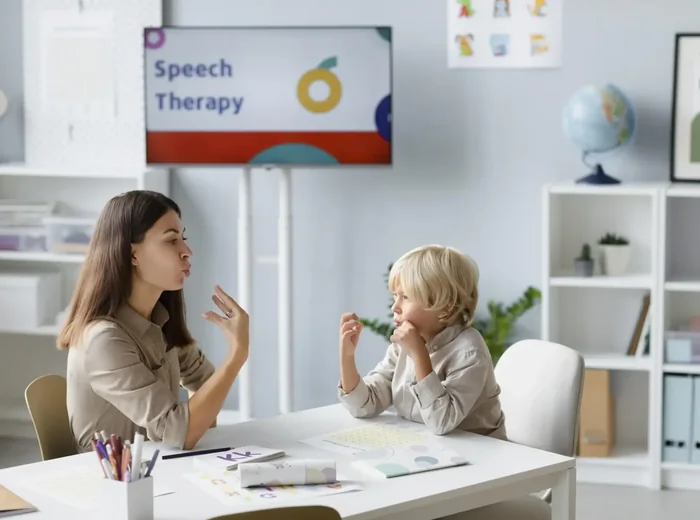
First, the honest boundary. We do not perform hearing tests and we do not diagnose auditory processing disorder. That diagnosis belongs to an audiologist, and if your child has not had a full hearing evaluation, that is the first call to make. We will tell you so at the evaluation rather than after six months of therapy. What we treat is the language and listening side, and it is a large side. We build the skills the classroom actually asks for: hearing the difference between close sounds, holding a longer sequence, following directions with more than one part, and pulling meaning from a sentence at real speed. We work in noise on purpose, because a quiet therapy room is not the room your child is struggling in. We also give you and the teacher the changes that cost nothing and help immediately: where he sits, how a direction is phrased, what to repeat and what to rephrase instead. Sessions are one on one and you are in the room. At the evaluation you get an honest estimate of how long this takes, not a promise.
What to expect.
Pinpoint
The first visit is an evaluation. We look at how your child follows directions, how much he can hold and repeat back, how he handles background noise, and what his language looks like underneath the listening. We ask what the teacher sees. If the right next step is an audiologist or a school evaluation team, we say so plainly and we tell you why.
Prime
Then we build the underlying skills in a targeted order: sounds first, then sequences, then longer stretches of language held at speed. Practice is short, specific and repeated, because these skills respond to structured repetition rather than to more listening in general. You get the home version, so the work continues in the car and at the dinner table between visits.
Perform
Last, we move it into the room where it has been going wrong. We add noise, add distance, and add the pace of a real classroom, then hand you and the teacher a short list of accommodations that keep working after therapy ends. Before discharge you leave with a home plan and clear things to watch for as the school year gets harder.
Listening rarely struggles alone.

Dyslexia Support
The same sound awareness that carries listening carries reading. Structured literacy support.
Speech, Fluency & Language Support
Late talkers, unclear speech, and children who understand far more than they can say.

Fluency Disorder & Stuttering
Repetitions, stretched sounds and blocks. What is ordinary, and when to stop waiting.