Dyslexia Support in Lafayette
She is bright. She knows the answer when you read the question to her. She read that word on the last page and not on this one. That is not laziness and it is not a phase, and there is a way to teach it that works.
What causes dyslexia?
You are not imagining it, and you are not the first parent told she will catch up. Dyslexia is a difference in how the brain connects sounds to letters. It has nothing to do with intelligence, effort, vision, or how much you read at bedtime. We do not diagnose dyslexia here. A formal identification comes from an evaluation team. What we do is the structured literacy work a child with dyslexia needs, whether or not the label is on paper yet.

At the centre of dyslexia is difficulty hearing and manipulating the individual sounds inside words. If a child cannot reliably pull cat apart into three sounds, or tell you what is left when you take the s off stop, then letters have nothing stable to attach to. Reading becomes memorising shapes, which works for a hundred words and collapses at a thousand. This is the skill direct structured teaching builds, and it is why more reading practice on its own rarely fixes anything.
Dyslexia runs in families. If a parent, sibling, aunt or grandparent struggled to read, spelled poorly as an adult, or avoided reading out loud, the odds go up considerably. Many parents recognise their own school years in the middle of their child's evaluation. Family history is one of the reasons not to wait: it turns a maybe into a probably, and the early school years are the ones where structured teaching does the most work for the least effort.
English is not fair, but it is more regular than it looks. A child builds reading by mapping sounds onto letters and letter patterns until the mapping runs without effort. In dyslexia that mapping stays effortful. A word gets decoded slowly on one line and is not recognised on the next, because it never got stored. Guessing from the first letter, from the picture, or from the shape of the sentence is what fills the gap, and it is the habit that most needs replacing.
A child who spends all of her attention decoding has none left for meaning. She reads the sentence correctly and cannot tell you what it said, which gets misread as a comprehension problem and treated as one. Fluency is not about speed for its own sake. It is about making the decoding cheap enough that the brain can think about the story. That is why fluency work sits in the middle of a good plan rather than at the end of it.
Spelling exposes the same gap from the other side. A child may recognise a word on sight and still have no idea how to build it, because building it means holding the sounds in order and knowing which pattern spells each one. Spelling errors that are phonetically reasonable, letter reversals past the age where they are ordinary, and the same word spelled three ways in one paragraph all point at the same processing difference rather than at carelessness.
Reading is language on paper. A child with a history of late talking, unclear speech, ear infections, or difficulty following spoken directions carries that history straight into the reading years. Vocabulary, grammar and the ability to hold a sentence in mind all decide how much a child gets from a page. This is why speech and language work and literacy work belong in the same room, and why the history you give us matters as much as the reading itself.

How structured literacy support in Lafayette helps.
The boundary first, because it is the question you arrived with. We do not diagnose dyslexia and we do not perform psychoeducational testing. A formal identification comes from an evaluation team, usually through the school or a psychologist. If that is the right next step we will tell you and point you toward it. A child does not need the label to start the work, and the work does not change much once the label arrives. What we do is structured literacy: explicit, sequential, multisensory teaching of the sound system and how it maps onto print. Sounds and syllables first, then letter patterns, then the rules that make English behave, each one taught directly and practised until it is automatic rather than guessed at. Spelling is taught alongside reading because they are the same knowledge in two directions. Underneath that we treat the language: vocabulary, grammar, listening, and holding a sentence in mind. Sessions are one on one, you are in the room, and you leave the evaluation with an honest estimate of the timeline rather than a comforting number.
What to expect.
Pinpoint
The first visit is an evaluation of the skills reading is built on: sound awareness, letter and sound knowledge, decoding, fluency, spelling, and the spoken language underneath all of it. We take the family history seriously. You leave knowing where the breakdown actually is, whether a formal dyslexia evaluation is the right next step, and what a realistic timeline looks like.
Prime
Then we teach the code directly, in order, without skipping. Sounds, then patterns, then the rules, each one introduced explicitly and practised until it runs without effort. Nothing is guessed from a picture or a first letter. Progress is tracked skill by skill rather than by grade level, so you can see movement long before a report card does, and you get the home practice that keeps it moving.
Perform
Last, the skills have to work on a real page. We move from word lists and controlled text into books, homework and the reading a classroom actually assigns, and we build the fluency that lets comprehension come back. Before discharge you leave with a home plan and the specific accommodations worth asking the school for, so the gains hold.
Reading rarely struggles alone.

Children's Auditory Processing
Hearing is fine, but the words get lost in a noisy room. Listening and language support.
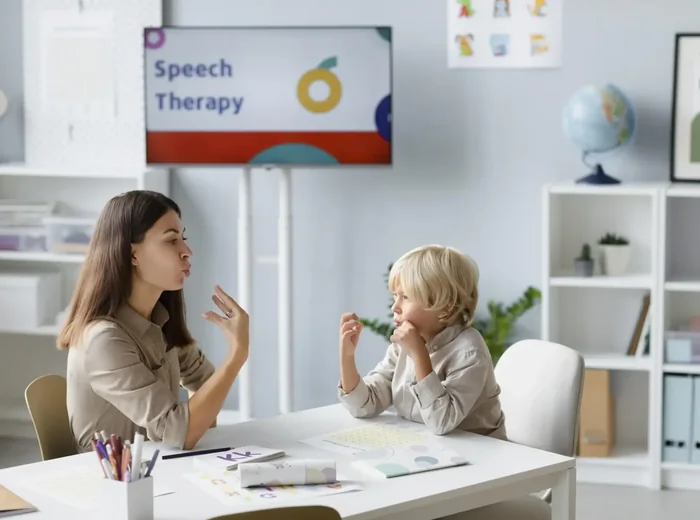
Speech, Fluency & Language Support
Late talkers, unclear speech, and children who understand far more than they can say.

Fluency Disorder & Stuttering
Repetitions, stretched sounds and blocks. What is ordinary, and when to stop waiting.